Week of Sept. 13-19, 2026
This week we bid adieu to the brightest planet in the heavens: Venus. For the past few months, it has glistened like a jewel in our western sky at dusk, but now it's appearing lower at dusk each night, soon to disappear from our evening sky.
Don't be too concerned, though; it'll be back in the fall of 2027. In the meantime, you'll be able to see it shining brilliantly in the predawn sky beginning sometime in November.
Why Venus behaves like this is a question that bugged early skywatchers. In fact, many believed it was actually two separate entities rather than one. The ancient Greeks, for example, knew it as Hesperos when it shone in the evening sky, and Phosphoros when it appeared in the early morning.
Today, of course, we know Venus as a planet that orbits the sun and, from our vantage point on the Earth, appears to flip from one side of the sun to the other. Right now we see it to the east of the sun, so it sets shortly after the sun. Soon, however, it will cross between us and the sun (not exactly, but close) and will emerge on the sun's western side. When it does, it will set before sunset and also, as it must, rise before sunrise.
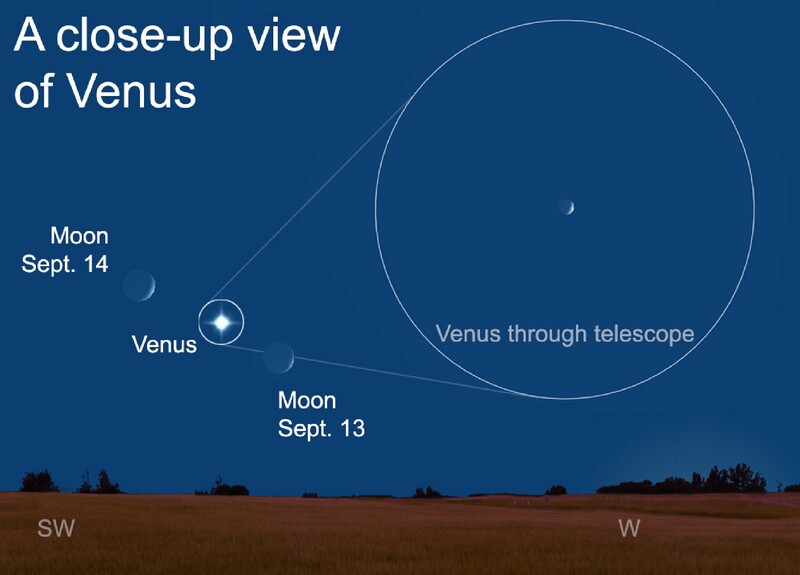
Meanwhile, we get to see it for a few more days during dusk. And, on the evenings of Sept. 13 and 14, the crescent moon will pass by this planet on its way around the Earth and will create a stunningly beautiful sight.
Venus appears so dazzling because it is a world roughly the size of our own and is shrouded by thick white clouds that reflect into space two-thirds of all sunlight that falls on them. This week, Venus appears even brighter than normal because it now lies relatively nearby, "only" some 41.8 million miles away from us. This means that it stands between the sun and the Earth and is lit by sunlight mostly from behind, producing quite a striking sight.
Aim a small telescope toward Venus this week and you'll discover, as Galileo did four centuries ago, that the planet appears not as a tiny dot but as a crescent — not unlike the moon.
While seeing a crescent Venus may not seem like an epic discovery in today's fast-paced, high-tech world, it was this simple observation that led Galileo to conclude that this planet could not possibly be orbiting the Earth as both the ancient Greek philosopher Aristotle and the Catholic Church had taught at the time, but instead had to circle the sun.
In other words, this observation helped to change our view of our place in the cosmos, because it meant that the Earth could not be the center of the universe as had long been believed.
Now if you don't have a telescope of your own, you can still enjoy this wonderful sky show with your own eyes. Or you can check out your local amateur astronomy club that offers free star parties where you can view this splendid sight through telescopes, as well as many other wonders of the heavens.
Visit Dennis Mammana at dennismammana.com. To read features by other Creators Syndicate writers and cartoonists, visit the Creators Syndicate website at www.creators.com.
Venus has been visible for the past few months but will soon disappear from the evening sky.






View Comments